
Meet Katherine
If you are trying to work out what AI could genuinely do for your business, it can be difficult to know whose advice to trust.
There is no shortage of people calling themselves AI experts. Some are highly capable. Others are simply a little further ahead than the person they are speaking to.
That difference matters.
Katherine created AI dojo because she wanted people to build real AI capability of their own. Not just learn a few prompts, but understand enough to make good decisions, build useful systems and know when AI is, and is not, the right answer.
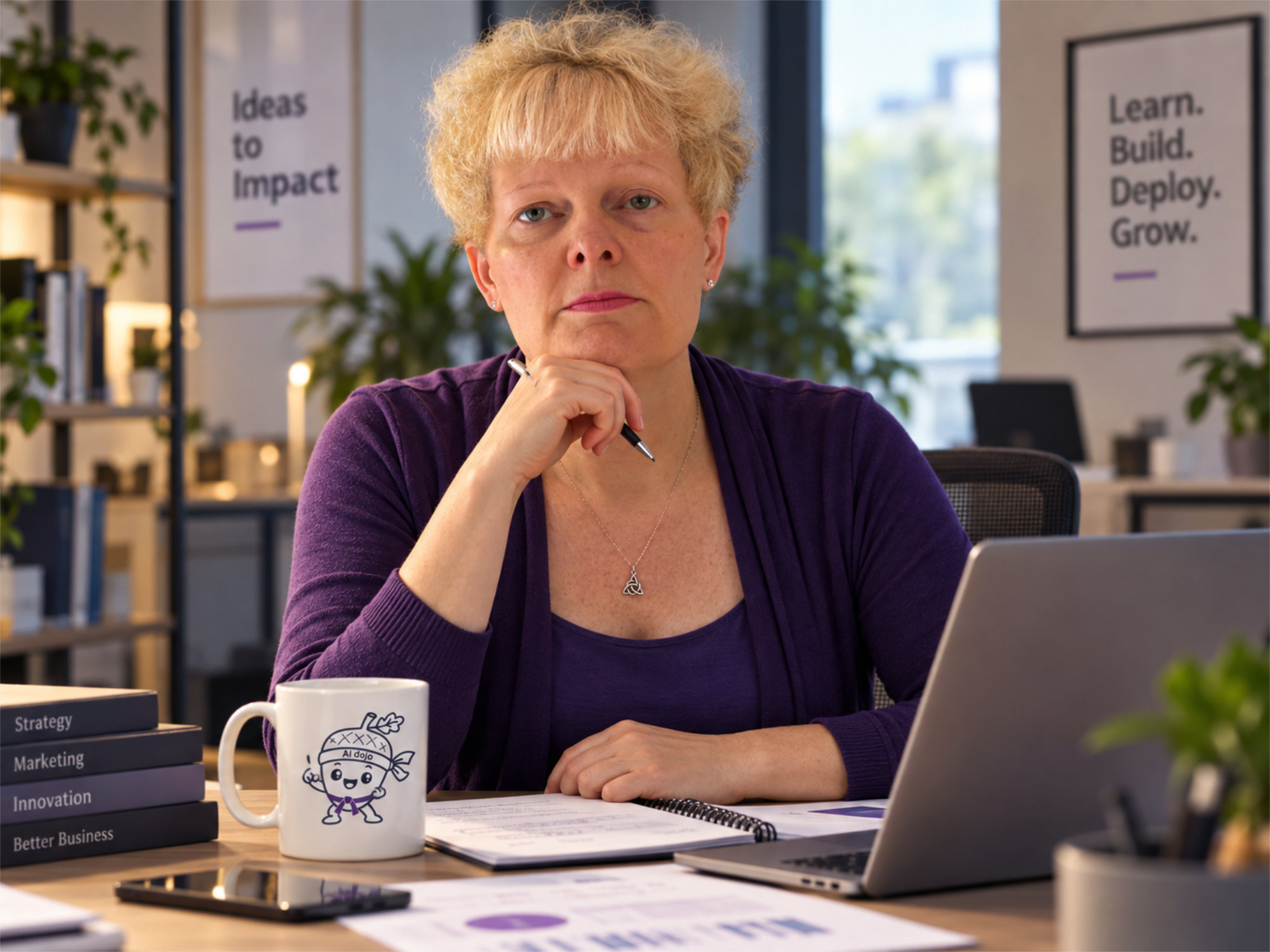
Katherine working on a client project
AI is not new to Katherine
Katherine first started working with artificial intelligence in 1989.
Her PhD in Electrical and Electronic Engineering included neural networks, chaos theory and analogue chip design. She developed two neuron models and explored how they could be used in different applications, with the longer-term aim of building them directly into electronic chips.
Then the AI bubble burst and the funding disappeared.
That experience gives Katherine a useful perspective on today's excitement around AI. She has seen the technology go through periods of high expectation before.
The difference now is that generative AI has become genuinely useful to businesses. It is faster, more capable and able to perform work that can create real value.
That is where Katherine believes the opportunity lies.
Not in using AI everywhere, but in using it where it makes sense.
Start with the work, not the technology
Katherine takes a practical view.
If a task is repetitive, can be explained clearly and follows visible steps, it may be a good candidate for AI.
But that does not automatically mean it should be automated.
Building a useful AI system takes time. It needs testing, maintenance and review. The value it creates should be comfortably greater than the effort needed to build and run it.
Sometimes AI is the right answer.
Sometimes a simpler process, better data or ordinary software will do the job perfectly well.
At AI dojo, we care more about the result than the technology used to get there.
Teaching that leads to real capability
Katherine is also a qualified teacher with a PGCE and has taught engineering and business at post-16, undergraduate and postgraduate level.
Her teaching has always focused on helping people use what they learn.
When she taught project management, she did not want students to spend the whole course listening to lectures and then sitting an exam.
Instead, she divided the class into teams.
At the end of each lesson, the teams were given subjects to investigate. Members divided the work between themselves, carried out their own research and brought what they had learned back to the group.
Katherine observed the discussions, checked their understanding and helped them work through problems as they appeared.
The students were not always convinced this was the favour Katherine thought it was.
Later, some came back and told her it had been one of the most useful classes they had taken at university.
The reason was simple. They had learned more than project management. They had learned how to work with other people, depend on colleagues and contribute to a team.
That same approach shapes how we work at AI dojo.
Understanding the theory matters. Being able to use it matters more.

AI dojo Katherine working on a client project
Meeting you where you are
Everyone starts from a different place.
You may already use AI every day, or you may still be trying to understand where it could fit into your business.
Both are reasonable starting points.
Katherine adapts the way she works to the people in front of her. Some people understand an idea better through a diagram. Others want to talk it through. Some need practical examples, stories or the chance to work through a problem themselves.
This also reflects the way Katherine thinks.
She does not have a mind's eye, so she does not mentally visualise things in the way many people do. That has made her particularly aware that people learn and process information differently.
The goal is never to make someone feel behind.
It is to help them understand enough to move forward with confidence.
The business of business
Katherine's experience goes well beyond technology.
As a management consultant, she has worked across sales, marketing, operations, negotiation, strategy and business growth.
She describes her speciality as the business of business.
That means understanding how the different parts of a company affect one another.
Does marketing understand what sales needs?
Does sales know what operations can actually deliver?
Is knowledge trapped with one person?
Where is work being repeated?
Where is a process creating more effort than value?
These are the kinds of questions Katherine has spent years helping businesses answer.
She is also the author of Master the Sales Process and Business Negotiation.
That wider experience matters because AI rarely fixes a business problem on its own. The process, people and technology all need to fit together.
From problem to working solution
The part Katherine enjoys most is taking something from problem to working solution.
That combines the two things she enjoys most: people and problem solving.
She likes understanding why something is not working, finding the friction and then helping to build something better.
Earlier in her career, Katherine architected storage used to archive very large volumes of banking transaction data.
Years after she moved on, that work was still quietly doing its job.
She likes that idea.
A good system does not need to demand attention. It simply needs to keep being useful.
Making more room for what matters
There is also a personal reason Katherine cares about removing repetitive work.
Since 2021, she has lived with Horner's syndrome and other health difficulties that have made parts of life more complicated.
It has changed the way she thinks about time, energy and the assumption that tomorrow will always offer the same possibilities as today.
That is one reason she believes technology should do more than help people produce more work.
Used well, AI can reduce some of the repetitive tasks that consume skilled time and energy.
That can create more room for better work, better decisions and life outside work.
For a small business owner, that might mean more time with customers, more time developing the business, or simply finishing the day with some energy left.
That matters too.
Safe hands, without creating dependence
AI dojo is here to help you become more capable, not more dependent.
Katherine brings decades of experience across AI, technology, teaching and business, but the aim is not for you to rely on her judgement forever.
It is to help you develop your own.
You should leave with a clearer understanding of what AI can do, where it could help your business and what good looks like.
You should be able to ask better questions, recognise poor advice and make more confident decisions about the systems you build.
You do not need to know everything before you begin.
You just need to be prepared to start.
That is what we want AI dojo to be.

AI dojo mascot
Get in touch to work with Katherine.
Company Information
AI dojo is a trading name of DVANA®,registered in England & Wales as company number 05251402, and is VAT registered as GB 993309194.
Please use the Head Office address for all correspondences, unless directed otherwise.
Head Office
AI dojo
20-22 Wenlock Road,
London.
N1 7GU
Admin Office
AI dojo
19 Vicarage Gardens,
Llandudno,
Conwy.
LL30 1RG
Registered Office
AI dojo
20-22 Wenlock Road,
London.
N1 7GU
AI dojo
20-22 Wenlock Road
London
N1 7GU
GB
0333 006 3800,
info(at)dvana.com